Whaling
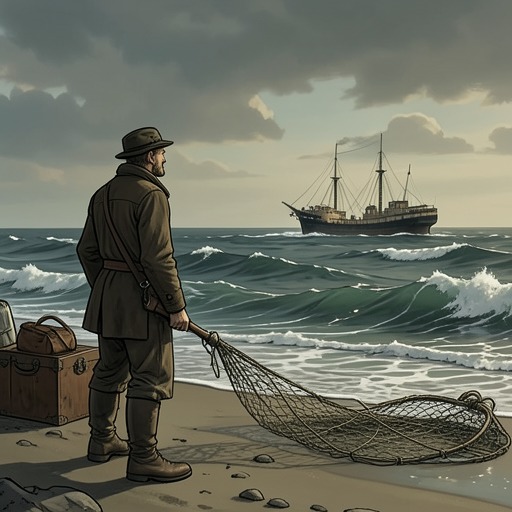
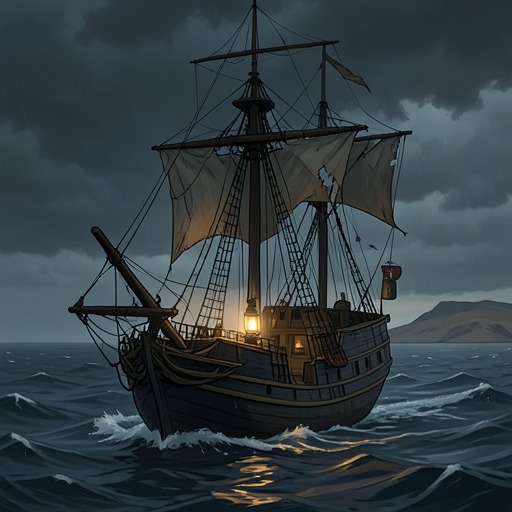
The WhaleWhaling joins the sea to the economies and social structures of the shore: ships pursued whales across distant waters, crews transformed their bodies into marketable goods, and ports built wealth from the catch. The practice is at once a history of enterprise and labor and a history of ecological depletion. Its changing methods—from candle manufacture and sail-era voyages to factory ships and industrial-scale processing—made the whale increasingly legible as a resource, even as the book emphasizes how much of the animal’s life and social world remained unknown.
A global industry and its port communities
The book’s index maps whaling across a wide geography: from the Arctic and Alaska to Japan, Norway, the Azores, South Georgia, and the Falkland Islands, and from ports including Nantucket, Whitby, and New Bedford of Whaling's Decline and Whale-Oil Industry Debates. It distinguishes Aboriginal whaling from commercial fisheries and tracks the industry through periods of growth, decline, restriction, and international regulation. This range makes whaling more than a local maritime custom: it was a connected enterprise whose reach followed both whale populations and the changing demands of markets.
The crews and communities behind that enterprise were also diverse. By the second quarter of the nineteenth century, one in twenty residents of New Bedford of Whaling's Decline and Whale-Oil Industry Debates was Black, and the town’s whaling population included Africans, Indigenous people, Azoreans, and Cape Verdeans as well as American-born sailors. In 1838, Frederick Douglass escaped enslavement dressed as a sailor and arrived there; for four years he worked at varied manual jobs, including rolling casks and stowing ships. The book connects this world of maritime labor to Ishmael’s description of a whale ship as an education and a shipyard as a schoolhouse. The comparison suggests how the industry could provide work and practical knowledge while remaining part of a society structured by racial inequality. The broader account also notes that shipboard bunks could be segregated and that, late in the century, men of colour were disproportionately represented in whaling-crew photographs.
Turning whales into commodities
Whaling’s economic force depended on converting different parts of the animal into products. Whale oil and baleen underwrote a transfer of wealth from ocean to shore: the book describes New Bedford’s elaborate houses and gardens as fortunes drawn from the Atlantic, Pacific, and Indian oceans, with each civic extravagance carrying the cost of a whale’s death. The material link between capture and consumption was not abstract. A whale’s oil supplied fuel and other goods, while baleen could be shaped into umbrellas, corset stays, Venetian blinds, or brush bristles.
The candle trade offers a particularly detailed view of this commodity chain. Introduced to New England in 1748 by Jacob Rodriques Rivera, the process used headmatter from sperm whales. Workers heated it in large kettles to remove water and impurities, then cooled the resulting material in casks over winter. They packed it into woollen bags and pressed it in wooden equipment to extract Spermaceti. The first, purest pressing was called winter-strained sperm. The residue was stored until spring, re-pressed as spring-strained oil, and pressed a third time; the remaining material was heated with wood shavings and potash to produce white wax. The sequence extracted successive products from a single supply of raw material, and the book notes that the process made fortunes.
Industrial whaling extended this logic from manufactories to processing ships. When the whale-ship Balaena returned to Southampton in May 1948 after an Antarctic season, it carried 4,500 tons of Whale meat, 163,000 barrels of edible oil destined for margarine, 10,000 barrels of sperm oil, 170 tons of meat extract, and another 3,000 tons of meat for cattle fodder. The ship itself had laboratories, a blacksmith’s shop, and a hospital. Its size and cargo presented whaling as a contribution to Britain’s post-war economy, while showing how a single voyage could feed several markets at once.
Labor, machinery, and the scale of the hunt
By the mid-twentieth century, capture and processing had taken on an explicitly industrial scale. In 1948, a Japanese expedition sailed six thousand miles to the Antarctic with six catcher boats, a factory ship, processing vessels, an oil tanker, and cold-storage ships. The fleet used radar to navigate through fog and processed its catch at sea. One Blue whale weighed 300,000 pounds; its tongue weighed three tons, and its body was reduced to usable material. Aboard the ships, blubber was rendered in steel boilers and stored in large tanks, while a process extracted oil from the liver. The animal yielded 133 barrels of oil and sixty tons of meat valued at $28,000.
This productivity coexisted with the human costs and regulatory contradictions of the work. Wounded crew members in remote waters could die because there was no hospital to take them to, even as factory ships processed whales and official observers watched. Rules prohibited targeting mother-and-calf pairs, yet pregnant animals were still killed; the book records one Blue whale mother surviving nine harpoons and five hours before dying. The account places such episodes within a practice conducted far from shore, where the distance from ordinary oversight could obscure responsibility even as the catch was made economically valuable.
Depletion and the changing meaning of whaling
The consequences were especially severe for Right whales. Their abundance of blubber, buoyancy after death, and tendency to remain near shore once made them convenient targets. Their Baleen also had many uses, from clothing supports to household goods. The book reports that fewer than four hundred North Atlantic right whales remained, and that despite protection from hunting beginning in 1935, shipping and entanglement continued to threaten them. Many were caught in fishing line, while ship strikes killed animals including females of calf-bearing age. Stormy Mayo, who began recording right-whale data after helping found the Center for Coastal Studies in Provincetown in 1976, became the first person licensed by the government to rescue entangled whales. His work marks a reversal in the use of maritime knowledge: techniques and equipment once associated with pursuit could be adapted to intervention and rescue.
The ecological loss reaches beyond the number of animals killed. Research on sperm whales cited in the book suggests that hunting removed not only individuals but also cultural knowledge about how to use particular habitats. The remaining population was growing at only about one per cent a year, a slow recovery for a slow-breeding animal. The account also warns that extinction can proceed after direct hunting has eased: the Yangtze River dolphin was declared extinct while the book was being written, and the sperm whale’s future remained uncertain. Whaling therefore altered populations, social knowledge, and the prospects for survival across generations.
Regulation and the limits of recovery
The book follows whaling from a largely commercial enterprise toward a contested international regime of restrictions. Its index records restrictions, an international moratorium, and the industry’s decline in America, alongside evidence that commercial activity continued in different regions. The 1986 International moratorium on commercial whaling may have arrived just in time for sperm whales, but the text presents it as no guarantee of recovery: slow reproduction and the long effects of earlier removals remain consequential. In Norway, commercial whaling resumed in 1992 despite the moratorium’s continuing presence, illustrating the conflict between conservation rules and claims that whales remain a legitimate resource.
That conflict changes the meaning of the practice without erasing its history. Whaling created wealth and supplied fuel, materials, and food; it also drew labor from communities shaped by racial inequality and left depleted populations whose recovery could be slow or impossible. The book’s account keeps these outcomes in the same frame: the industrial chain that made whale products valuable also made the animals’ disappearance a foreseeable cost of the enterprise.